Ukulele Lessons for Beginners in Hawaii: Everything You Need to Know Before You Start
By Aaron Cardenas | Maui Guitar & Ukulele Lessons | Yale-Trained Instructor | Online Lessons Available Statewide
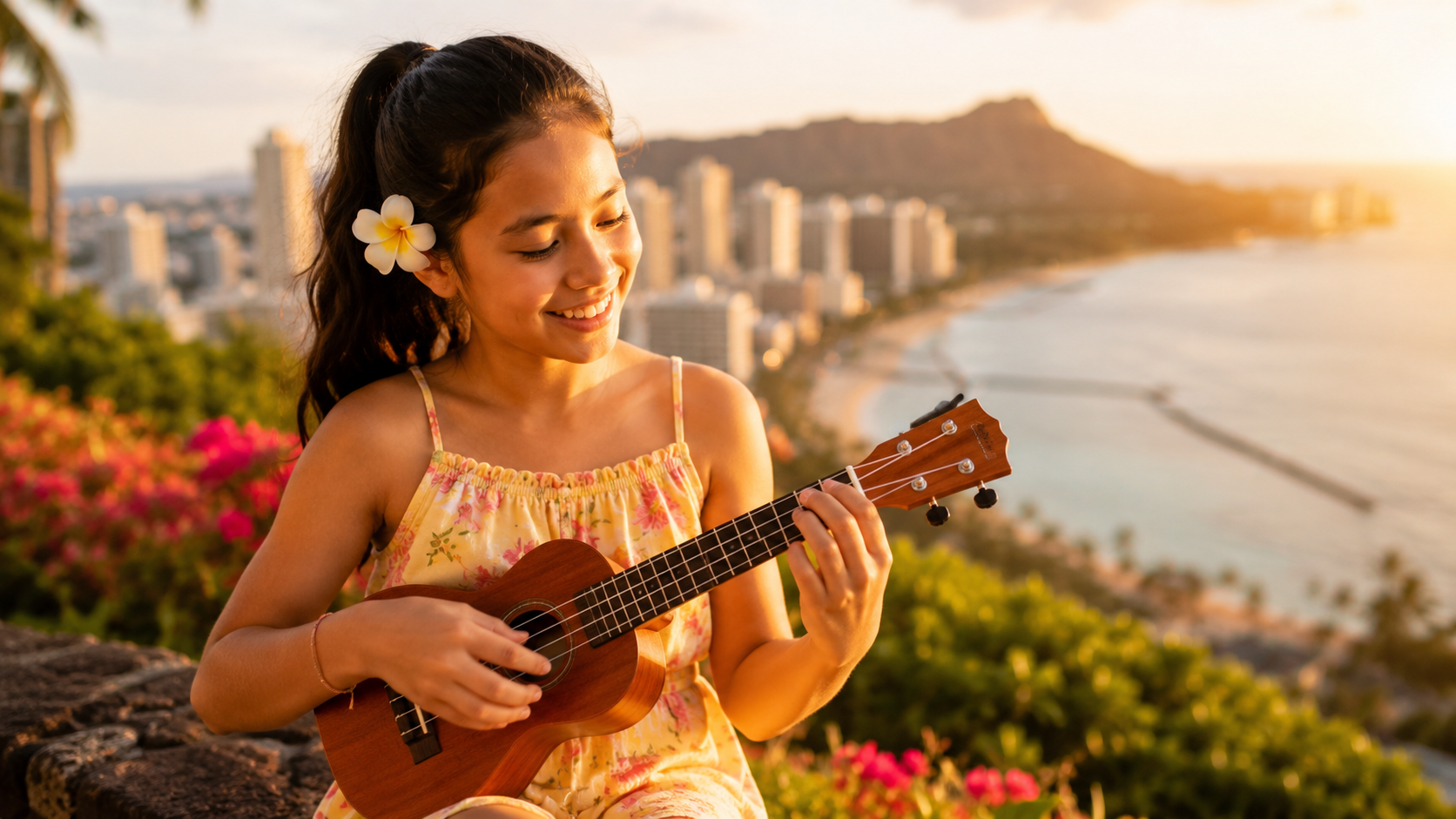
You've been thinking about it for a while — maybe your child came home humming a Hawaiian melody, or you spotted a ukulele at a shop in Waikiki and felt a pull toward it. Whatever brought you here, if you're searching for ukulele lessons in Honolulu or anywhere in Hawaii, you've landed in the right place.
As a Yale-trained musician with over 20 years of private teaching experience, I've helped students from age 3 through adulthood discover the ukulele — and I offer online lessons that serve students across the entire Hawaiian Islands, including Honolulu, Kailua, Pearl City, Aiea, and beyond.
In this guide, I'll walk you through everything a beginner needs to know: why the ukulele is a perfect first instrument, what to expect from your first lessons, and how to find the right teacher for your needs.
Why the Ukulele Is Hawaii's Perfect Beginner Instrument
The ukulele isn't just the official instrument of Hawaiian culture — it's one of the best instruments on the planet for beginners of any age. Here's why students across Honolulu and the rest of Hawaii fall in love with it:
It's Genuinely Easy to Start
The ukulele has just four nylon strings, a compact body, and a tuning that makes basic chords accessible within the first lesson. Most beginners can strum a recognizable song within their very first session. That early win is powerful — it builds confidence and makes a student want to come back and practice.
Compare that to piano, which requires both hands doing completely different things from day one, or violin, which takes months before it doesn't sound like a cat in distress. The ukulele gives you immediate musical reward.
Soft Strings That Are Kind to Fingers
One of the most common reasons people quit guitar early is finger pain — steel strings are genuinely rough on beginners' fingertips. The ukulele uses nylon strings with lower tension, which are gentle on young or adult hands alike. Children especially benefit from this; there's no painful barrier between them and their first songs.
Small, Portable, and Built for Hawaii's Lifestyle
The ukulele fits into an ohana. It travels to the beach, to the park, to grandma's house. Its compact size makes it easy to store, easy to carry, and — for keiki — easy to hold. In a state where music is woven into everyday life, the ukulele fits naturally into the rhythm of Hawaiian living.
A Connection to Hawaiian Culture and Heritage
There's something special about learning an instrument that is deeply rooted in the place you call home. The ukulele arrived in Hawaii in the 1880s, brought by Portuguese immigrants, and was quickly embraced and transformed into a uniquely Hawaiian art form. Learning the ukulele in Hawaii isn't just a music lesson — it's a connection to your culture, your history, and your community.
What to Expect from Beginner Ukulele Lessons
Whether you're signing up yourself or enrolling your child, here's what well-structured beginner ukulele lessons should cover:
The First Few Lessons: Foundation
In early sessions, a good instructor will cover proper holding technique (sitting and standing), basic right-hand strumming patterns, and your first open chords — typically C, G, Am, and F. These four chords alone unlock hundreds of popular songs.
The most important thing in the beginning is building good habits: relaxed posture, clean fretting without muffling adjacent strings, and a natural strumming motion. Bad habits developed early are hard to undo. This is why the quality of your first teacher matters enormously.
Building Your Chord Vocabulary
Within the first month, most students develop a working vocabulary of 6-8 chords and can move between them smoothly enough to play simple songs. Hawaiian favorites, pop songs, and folk standards all work beautifully on ukulele at this stage.
Reading Music vs. Learning by Ear
Some students thrive learning by ear and through chord charts or tabs. Others benefit greatly from learning to read standard notation — especially younger children who may go on to participate in school music programs. In my lessons, I tailor this to the student: we use what serves them best, and I always make sure they leave with real musical literacy, not just memorized patterns.
Strumming Patterns and Rhythm
Hawaiian ukulele playing is deeply rhythmic. Beyond just strumming down on the beat, you'll learn syncopated patterns, fingerpicking, and the iconic island swing feel. This is where the ukulele really comes alive — and it's one of my favorite things to teach.
Online Ukulele Lessons: Why They Work Beautifully for Hawaii Students
If you're in Honolulu and looking for private ukulele instruction, online lessons are an excellent option — and in many ways, they're better than driving across town.
Here's why online ukulele lessons work so well:
For students on Oahu, commuting to a music studio can eat up an hour of your day. Online lessons eliminate the drive, the parking, and the schedule friction. You practice in your own home, with your own instrument, in a comfortable and familiar space — which research consistently shows leads to better learning outcomes.
As someone who teaches students across the Hawaiian Islands, I've found that online lessons produce the same results as in-person instruction for ukulele. The instrument is small enough that camera framing is easy, tone is audible at conversational volume, and technique can be assessed and corrected in real time. I've taught families in Honolulu, Hilo, Kauai, and everywhere in between — all without anyone leaving home.
How to Choose the Right Ukulele Teacher in Honolulu (or Online)
With so many options — from group classes at community centers to private studios and online instructors — how do you choose? Here are the key questions to ask:
Does the teacher have formal music training? There's a meaningful difference between a hobbyist who learned a few chords and a teacher with a serious academic music background. Formal training means your instructor understands music at a deeper level — theory, technique, pedagogy — and can explain why, not just what to do.
Do they have experience teaching your age group? Teaching a 6-year-old requires completely different skills and patience than teaching a 40-year-old. Make sure your teacher has a proven track record with students like yours.
Will lessons be structured and progressive? Beware of teachers who just play through songs each week without a clear progression plan. The best instruction builds systematically — each lesson intentionally prepares the student for the next.
Can they teach music reading, not just tabs? This matters especially for children. A student who learns to read music has a lifelong skill. A student who only learns tabs has learned a shortcut with a ceiling.
As a Yale-trained musician with 20+ years of private teaching experience — including students as young as age 3 — I bring a level of musical depth and pedagogical expertise that's rare to find. My lessons are fun, encouraging, and rigorous in all the right ways. I want every student to fall in love with the ukulele and keep playing for life.
What Ukulele Should a Beginner Buy?
One of the most common questions I get from Honolulu parents and new students: What ukulele should I start with?
Here's a simple framework:
For young children (ages 3–7): A soprano ukulele is the standard beginner size — small, light, and easy to hold. Look for a reputable beginner brand (Kala, Lanikai, and Cordoba all make solid starter instruments) in the $50–$100 range. Avoid extremely cheap ukuleles that can't hold tuning; a ukulele that constantly goes out of tune is frustrating and discouraging.
For older children and adults: A concert ukulele (slightly larger than soprano) offers a fuller sound and a bit more room on the fretboard for adult hands. Budget $80–$150 for a good beginner concert uke.
For serious students: A tenor ukulele gives the richest tone and most playing versatility. Once a student has played for 6–12 months and is committed, upgrading to a tenor is a rewarding step.
I'm happy to advise any student on specific instrument purchases before or after their first lesson — it's one of the things I love to help with.
Start Your Ukulele Journey with a Yale-Trained Hawaii Instructor
Whether you're a complete beginner in Honolulu or a parent looking for the best possible start for your child anywhere in Hawaii, I'd love to be your teacher. My online lessons are available statewide — no commute required.
Here's what you get when you study with me:
Private, one-on-one lessons tailored entirely to you
Yale-trained instruction with 20+ years of teaching experience
Students welcomed from age 3 through adult
A structured, progressive curriculum that builds real musicianship — not just songs
Flexible online scheduling that fits Hawaii's busy lifestyle
All styles taught: Hawaiian, pop, fingerpicking, classical, and more
📍 Serving all of Hawaii online — including Honolulu, Kailua, Kaneohe, Pearl City, Kapolei, Hilo, Kauai, and the Neighbor Islands.
Book your first lesson today →
Frequently Asked Questions
How old does my child need to be to start ukulele? I've taught students as young as age 3. With the right approach, young children take to the ukulele beautifully — the small size of the instrument is a natural fit for small hands.
Do I need to buy a ukulele before the first lesson? Ideally yes, so we can immediately start playing. If you'd like a recommendation before purchasing, reach out before booking and I'll point you toward the right instrument for your age and budget.
How long does it take to learn ukulele? Most beginners can play simple songs within their first lesson. A committed student practicing 15–20 minutes daily will be playing confidently within 2–3 months and exploring more advanced material within a year.
Are online ukulele lessons as effective as in-person? In my experience teaching across Hawaii, yes — for ukulele especially. Video calls handle the instrument's size and volume range very well, and students often practice more consistently because lessons fit more easily into their schedule.
Aaron Cardenas is a Yale-trained musician and private instructor with over 20 years of teaching experience. He offers guitar and ukulele lessons to students of all ages — from age 3 through adult — online throughout Hawaii and in-person on Maui.